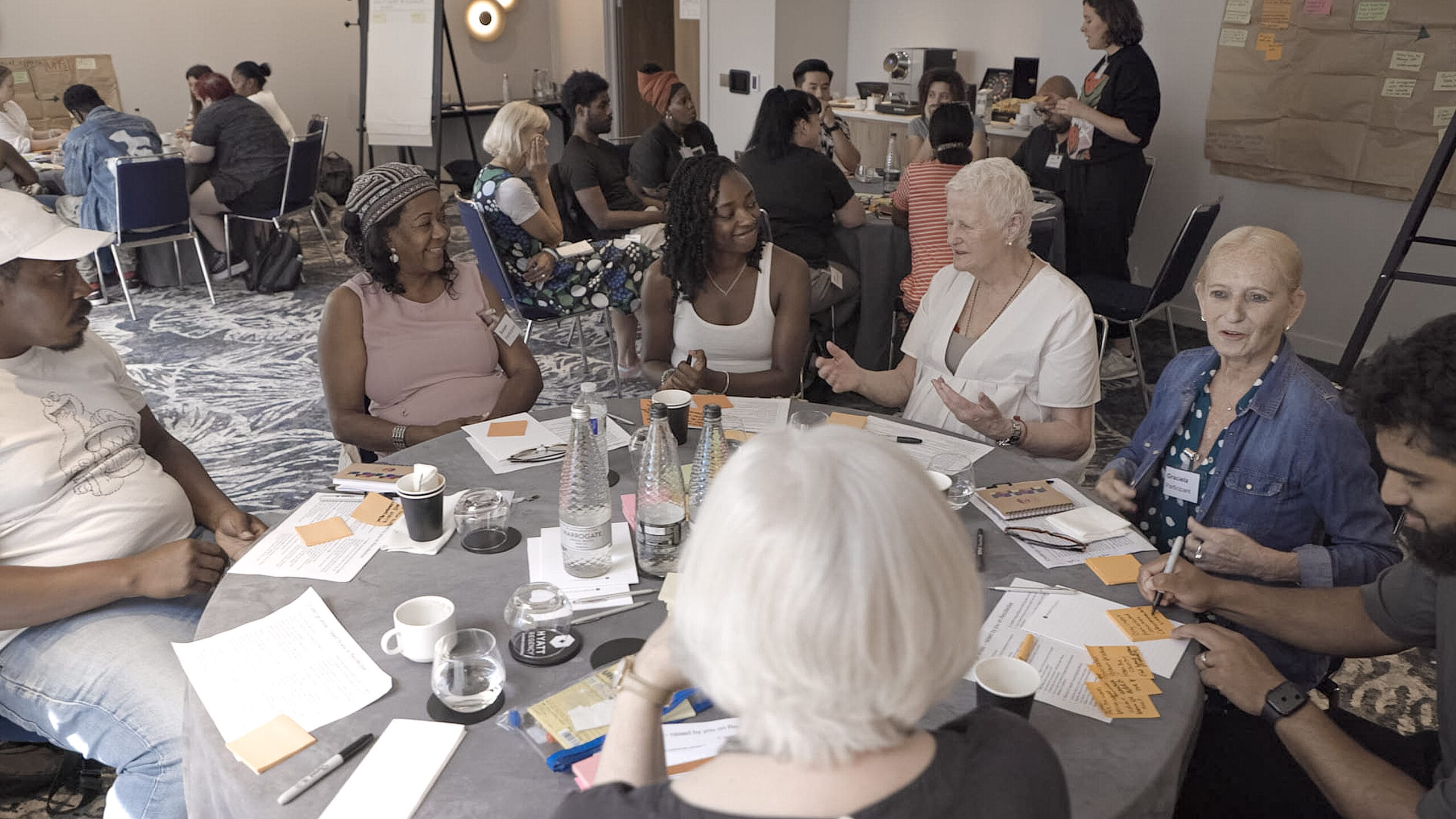
Henrietta Hopkins is the co-founder and director of Hopkins Van Mil (HVM), a specialist deliberative agency that describes its culture as being shaped by values of equity, inclusion and accessibility. Sciencewise programme lead, Trupti Patel, talks to Henrietta about her career journey, her experiences and some of the values that are foundational to the Hopkins Van Mil approach.
Trupti: Hi Henrietta, thanks for joining me today to talk a bit about your work. I know some of the projects that you’ve worked on have had really interesting equity elements. As a programme, Sciencewise has been looking at how equity is embedded into processes, but that immediately raises questions about what equity looks like in deliberative dialogue. So, we thought this would be a good moment to speak to a well-renowned practitioner in this space to understand what you think needs to be done to make equity a central element within deliberative dialogue processes.
Looking back, are there many projects that you’ve run or worked on that really stand out to you?
Henrietta: This is a really hard question because when I’m in a project, or when HVM is in a project, hearing those voices is the most important thing that’s happening for us. But, the two most recent dialogues, on Ultra Processed Foods (UPFs) and Solar Radiation Modification (SRM), both stand out for totally different reasons, as well as other work we did in the mid-2010s.
UPFs stands out because it felt like such an important, timely project. It felt as if it should have happened five years ago and it was so great that it was finally happening, especially after we’d done a lot of deliberative work in the food system space. We ran the largest public deliberation with the Food Farming and Countryside Commission, the Food Conversation, and we ran the Sciencewise National Food Strategy Public dialogue as a part of Henry Dimbleby’s Independent review. And they all pointed to UPFs as a gap, as an area that needed some focus.
And it was so important for that dialogue to include people who live in communities which are really fundamentally disadvantaged, with people who experience food poverty and people for whom, when they go out into their streets, the only options are convenience and ultra processed foods. And so it felt so important that we heard their voices and heard what they wanted to say and that they were empowered to create these reams and reams of recommendations around what kind of research UKRI should do on UPFs. So that felt really powerful.
Trupti: And then you mentioned SRM as well. Can you tell me a little more about that?
Henrietta: Yeah, so SRM felt powerful. What I really thought was fascinating about that deliberation is that we came into it completely open eyed. We knew that this was a really contested area of science. I don’t think we’ve been involved in anything where the scientific community are not in agreement, and so clearly not in agreement. There are binary views, like ‘you should have a moratorium on research’, or ‘we should go hell for leather for research. Because there’s nothing else. There’s no other Plan B for climate change’. So I found it fascinating to bring participants into a space where we were being really open that this is just a contested area.
‘Run with us, hear what people have got to say, hear the range of perspectives. Here’s the evidence we do have. Here are the grey edges where people aren’t clear’. And participants really got it. I think it’s a real endorsement of a situation where you give people evidence, you give people time, you give people interaction with specialists in the field and they will come up with stuff that’s really powerful.
And I remember when we pitched for that work we said we’d like the focus to be on face to face presentations. And we thought, actually, if we did some at the beginning and the end which were online, that allows us to get speakers from around the world who could really inform us of what’s been happening and why people might be concerned. It allowed us to involve the voices of indigenous communities and hear how they’ve been affected. This helped participants to think about this as a global issue, that climate change isn’t just something that affects the UK. It’s not in a box with borders. It’s a global issue.
It led to a really powerful conclusion, ‘please do not experiment on the Global South’. That they’re not a playground for scientists in Northern Europe or North America to come and test stuff on them to see if it’s okay for use globally.
Trupti: And, with science having more of an international focus nowadays and more of a global purpose, I think this was a really interesting element and I’d be interested to see if more dialogues actually do start looking at the international aspects to what people are discussing.
I’ve seen you have a strong portfolio of projects where inclusion is of the highest importance. How do you approach the factors around ensuring an inclusive approach at HVM?
Henrietta: So I think our approach is definitely that it’s embedded from the very beginning, from the very moment we start thinking about what we would put in our proposal to how the final report is, it’s just embedded. It’s a thread through absolutely everything, thinking about who by default could be disadvantaged or excluded from something.
So actively designing to make sure that doesn’t happen and thinking about who might be adversely affected by something as a starting point helps us to make sure we don’t do it by default ourselves by mistake. It’s a really important part of every weekly team meeting at HVM. It’s a really important part of all our thinking design. So it’s embedded through everything. Working with recruitment, which means sometimes using Sortition, is a way of addressing that, but sometimes it isn’t. Making sure we have boosted for demographics that are are not usually included in these discussions, making sure they are in the room and that no-one comes into a process and feels further marginalised by being the only one of a demographic in the room and feeling a pressure to represent a demographic or having a feeling that they’re token. That cannot happen in an HVM run public dialogue. So we think really carefully about boosting recruitment and sometimes having community voice sessions around the main process.
What do I mean by community voice? I mean smaller groups of people who work in and around the dialogue. They might be part of the dialogue or they might be completely separate. So, for the Whole Genome Sequencing for Newborn Screening public dialogue we ran, we really wanted to hear from people who were new and expectant parents, for example, because changes to screening of newborns would immediately impact them. We wanted to make sure young people as a group were heard. And some of the most powerful, most impactful findings from the whole dialogue came from that group of young people. So sometimes it’s actually not saying that everyone’s got to be in a room all at once, but that the voices who could be most adversely affected definitely need the space that they need. Whether that’s with everyone else, whether that’s separate, whether it’s a bit of both. It’s making sure it’s core to what we do. It’s not just something we think about as we recruit or at the end, we’re doing it throughout.
Trupti: What do you do about sensitivities, for example, when changes in policy or law might affect some population groups more than others?
Henrietta: I suppose we never approach sensitive topics as though they will be felt and experienced in the same way by everyone. I suppose that’s the critical thing. So when we’ve looked at food system programmes that have interventions like taxes or restrictions, we need to be mindful that those taxes and restrictions might have more adverse impacts on some people than others.
I find the peer quality of these discussions is important. So someone might say, ‘tax all producers of UPFs and make sure UPF food is really expensive’. And then someone else might say, ‘well, you could do that, but if you do that, that means there’ll be no food to buy in my local shop. So how do we change the whole food system so that my local shop has food I can buy that is healthy and affordable’. And so you have really subtle, nuanced discussions because the participants themselves are raising them. So I think trusting the participant dynamic is really important.
And making sure our facilitation is top notch and empathetic, so that facilitators can hear when people have a political point to make with a small piece of information and what that might mean for policy.
And hearing everyone, I guess it goes back to HVM being kind. We are kind and thoughtful in what we do and that is part of this.
Trupti: It’s almost like something that’s sort of inbuilt within the nature of the people running the processes and the people who are taking part in them.
What are the challenges and tensions in ensuring a range of participant perspectives are captured?
Henrietta: I mean, this question is huge, isn’t it? There are significant challenges and tensions. I suppose one of them is budgets because you are making trade-offs when deciding how many people there will be in the room, and how many people with different kinds of experiences. Our biggest budget line in any dialogue process is the incentives and the travel support for participants. And that’s as it should be, but it’s a big consideration and it’s something I think commissioners don’t always understand. We cannot run a process where anyone might be undervalued for their time and commitment or not able to attend because they don’t have enough support for caring costs or travel, or whatever it is.
The other tension is just time. So sometimes there’s a pressure from commissioners that we absolutely need to have the final report by a certain deadline. But actually we feel a workshop process that runs over two months is going to be much more useful in allowing people to surface what they want to say. You could do a process in two weeks, but you probably haven’t given them enough time to deliberate, to really think in a public dialogue sense.
There are also other tensions in how reflective the group is of the UK population and the depth of the conversation you have, so that you honour the complexity of the topic without dumbing down or oversimplifying it, and respecting that in a public dialogue people will get it. You provide them with the specialists, the information, whatever they need to take part properly, and they will get it.
Trupti: And have you ever faced challenges with tensions within a room as well? So thinking about different demographics within a room or different perspectives within a room?
Henrietta: Yeah, completely. And again, that goes back to really skillful facilitation.
I think the biggest, recent example is in the SRM public dialogue where we very deliberately made sure that we had people who did not believe in climate change to reflect that 3 to 4% of the population are climate change deniers. We had one person who was really conspiracy driven. He absolutely believed that there are chemtrails in the sky and that’s what SRM is, and that the government is pumping chemicals into the air every time an airplane goes up in the sky. And we had to change how we did things to make sure that his voice wasn’t the one voice we heard, but that he was given space to share his views. But it was actually very much that peer process, people saying, you know, sorry, but I’m not buying what you’re saying and thank you for sharing those views, but I fervently believe in climate change. It required very skillful facilitation to reassure this person they had been heard because one of their themes was, ‘you’re not hearing me, you’re still telling me that climate change exists’. And we’re saying, well, evidentially, climate change does exist and we are hearing you, but we are working in this evidence space.
And as with any group of people in society coming together, there are going to be tensions, particularly when you’re talking about really sensitive topics. I mean, as you know, we ran the citizens jury on whether the law on assisted dying should change in England with the Nuffield Council on bioethics. We had people with very opposing views, but made sure the space was somewhere people could share their views safely without harm, and that they knew they were being supported. All those things are really critical.
Trupti: Finally, what are some of the barriers you face when designing dialogues with an ethical approach, and how might they be overcome?
Henrietta: So, I think this is going to sound a bit fawning, sorry. But I think having Sciencewise is one of the principal ways of overcoming barriers, because it’s kind of expected that a Sciencewise process will be inclusive and equitable. You know, I wouldn’t feel I could call it a Sciencewise public dialogue if it didn’t have those checks and balances in place. The fact of having an evaluator, the lovely project team meetings, the oversight group. Having Sciencewise in the mix, saying, actually, if you want to call this a Sciencewise public dialogue, it’s got to have these things. And making sure that there’s no mission creep, that once you’ve got what you have, you don’t suddenly say, well, we need another.
And sometimes I think there is a culture shift needed in the commissioning space, which assumes if you’re engaging with public voice, it’s going to be a survey and that a survey is adequate. There’s still this real challenge about numbers, you know, so you’ve got a dialogue with 56 people. Can that really be powerful? And yes, it is, it’s really powerful. And you are allowing 56 people to explore something in really great depth over time and that will have much more power and impact for you than a survey of 2,000 people who spend 10 minutes. It’s the dialogic element.